How AI Companions Generate Photos of Themselves
The interesting question is not whether an AI can make a hot photo. It is how she stays the same woman in every photo. The identity problem, explained by people who ship it.
On this page6 sections
The question people type is "is there an NSFW AI image generator," and the answer is yes, obviously, dozens. The question they actually mean is better: how does an AI companion send you a photo of *herself*? Same face as her avatar, same body as yesterday's picture, new pose, new room, new mood. That is not what image models do by default. It is the hardest problem in this corner of the industry, we ship a version of it, and this is the plain-language explanation of how it works and where it still creaks.
Sixty seconds on how image generation works at all
A diffusion model is trained by taking millions of images, drowning them in static, and teaching a network to reverse the drowning. After enough of that, you can hand it pure noise plus a text description, and it will hallucinate its way backward to an image that matches the words. It is not collaging photos it has seen; it is painting from a statistical understanding of what things look like. "Woman, beach, golden hour" reliably produces a beautiful woman on a beach at golden hour.
Note what is missing from that sentence: *which* woman. The prompt describes a category, and the model samples from it. Run the same prompt twice and you get two different beautiful strangers. For a wallpaper, fine. For a companion, fatal.
The identity problem, which is the whole product
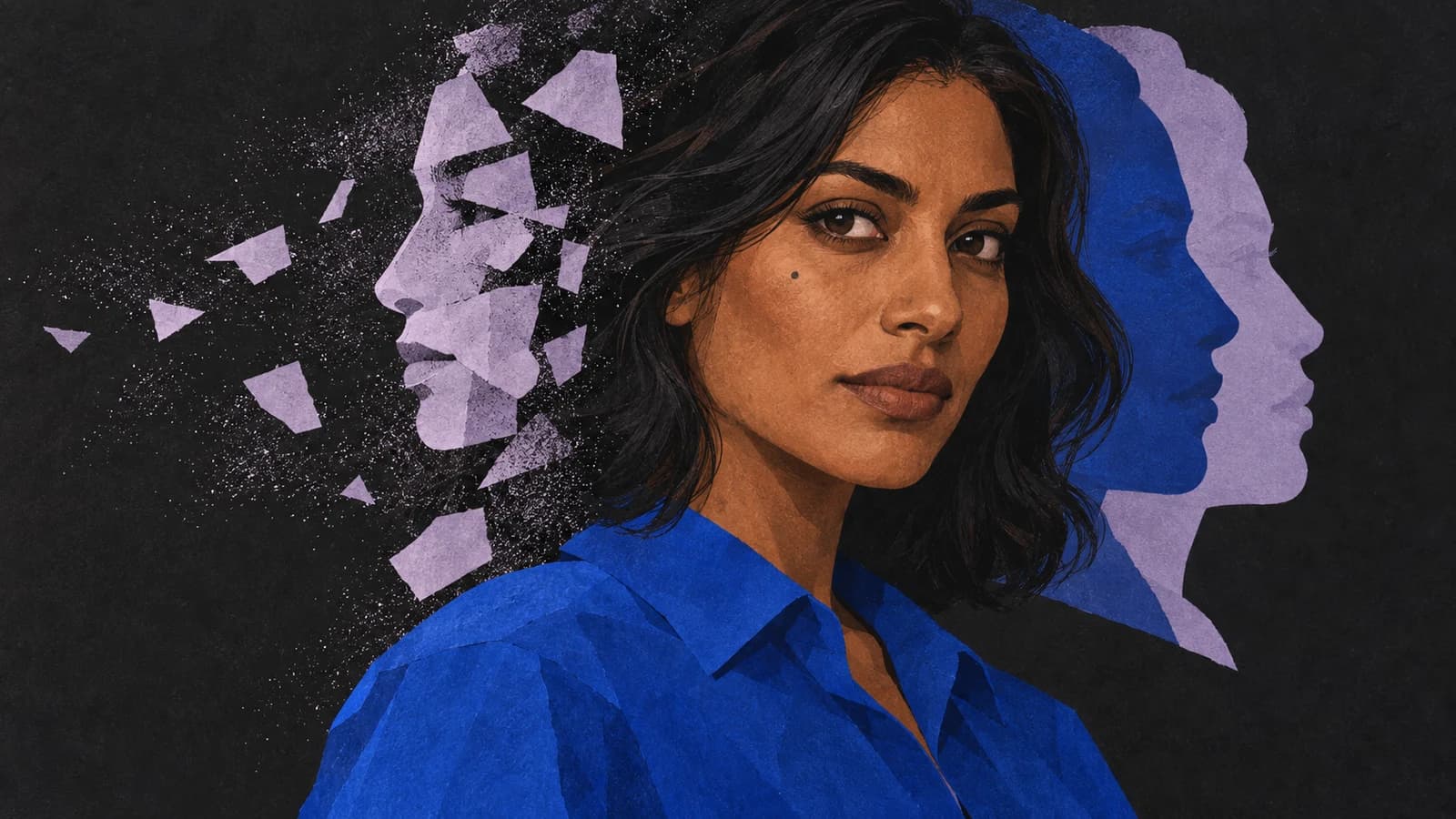
A companion is a specific person-shaped character. The photo she sends has to be her: the face from her avatar, the body from her last photo, the person you have been talking to for a month. A raw prompt cannot deliver that, because words underdetermine faces; "long dark hair, green eyes, sharp jawline" matches a million women, and the model will happily show you all of them, one per generation.
Anyone can generate a beautiful woman. The product is generating the same beautiful woman on Tuesday that you fell for on Saturday.
The industry's answer is to anchor identity outside the prompt. Each companion gets canonical reference imagery, made once, when she is created. Every subsequent generation is conditioned on those references as well as the scene description: identity techniques (face embeddings, reference conditioning, face-locking passes) hold who she is steady while the prompt controls what is happening around her. The base model paints the scene; the identity layer keeps the person in the scene from being recast. On Jizzy every roster companion and every custom-built one carries her own reference set, which is why the photos in chat stay recognizably her across weeks.
Why hands still go wrong, and other honest limits
Now the part vendors skip. Diffusion models learn appearances statistically, and some things are statistically miserable. Hands are the famous one: dozens of valid finger configurations, constantly occluded, and tiny errors read as horror where a slightly odd lamp reads as a lamp. Text on clothing, jewelry that crosses skin, mirrors, and the physics of tangled limbs are the same story. Production pipelines mitigate with automatic detection and regeneration of bad regions, which is a real fix and an imperfect one. If you want to train your eye on the rest of them, the tells that give a generated body away are almost all failures of physics rather than of rendering.
Identity has its own honest limit: consistency is strongest when a companion's look is distinctive. Strong features anchor; the more generically pretty a face, the more the model's gravity pulls it toward the average. And the more extreme the pose or angle, the harder the identity layer works. This is why every platform's gallery looks better than its worst output, ours included. If a vendor tells you their generator never misses, they are showing you the gallery.
From "generate an image" to "she sent you a photo"
The last piece is not a model at all; it is product design. A prompt box makes you the photographer: you describe, it renders, transaction over. A companion inverts the flow. You are mid-conversation, you ask for a photo (or she offers one, which is its own small delight), and what arrives is framed by the moment: her, in the mood of the scene you were already in. Same underlying diffusion machinery, completely different experience, because context is doing the work the prompt used to do.
On Jizzy specifically: photos arrive in chat blurred and unlock for 25 jizz (video clips 50), everything unlocked lives in a private gallery behind signed links only your account can open, and generation happens per request rather than from a pre-shot library, which is how she can be *in* the scenario you asked about. The fully explicit end of this machinery is the AI porn generator; the mechanics are identical, the register differs.
The bright line that keeps all of this legitimate
The same technology that keeps a fictional companion consistent could, pointed at photographs of a real person, produce explicit imagery of someone who never consented. That is not an edge case to manage; it is abuse, increasingly a crime, and the single line that separates a legitimate product from a harm engine. It is why there is no photo upload here, no likeness targeting, and no celebrity mode, and why every companion is fictional and AI-generated with hard walls against anything else. A generator that will "do anyone" is telling you exactly what business it is in. Walk.
The short version
Diffusion paints from statistics, which makes beautiful strangers cheap and consistent identity expensive. Companion platforms solve it by anchoring each character to reference imagery so the prompt controls the scene while the identity layer controls the person. Hands and edge cases still wobble, distinctive faces hold best, and the whole category stays legitimate only by refusing real people absolutely. That is how she sends you a photo of herself, and why the interesting word in that sentence was always "herself."
FAQ
Is there an NSFW AI image generator?
Yes, many, in two shapes: standalone prompt-box generators where you describe an image and get one, and companion platforms where a persistent character generates images of herself inside a conversation. The second shape is what this article explains, because it solves the problem prompt boxes cannot: the same woman, every time. All of it is 18+ territory, and the legitimate versions are strictly fictional.
How do AI companions keep the same face across photos?
By anchoring identity outside the prompt. Each companion has canonical reference imagery, and every generated photo is conditioned on it, so her face and build carry across images instead of being re-rolled from the text each time. The base model paints the scene; the identity layer makes sure the person in the scene is her.
Why do AI-generated hands and details still go wrong?
Diffusion models learn what things look like statistically, and hands are the worst case: dozens of valid configurations, constant occlusion, and tiny errors that read as horror. Platforms mitigate with automatic detection and regeneration of bad regions, which is why quality varies between one-shot generators and pipelines that clean up after themselves. Anyone claiming zero artifacts is lying or cherry-picking.
Can I generate images of a real person?
Not on any legitimate platform, and not on Jizzy, by design. Generating explicit imagery of real, identifiable people without consent is abuse and increasingly a crime. There is no upload and no likeness targeting here; every companion is fictional and AI-generated. The technology being able to do a thing does not make the thing acceptable, and this is the category's brightest line.
Are the photos she sends private?
On Jizzy, yes. Generated media lives in a private gallery behind signed, expiring links that only your account can open; nothing is public and nothing is shared. Whatever platform you use, check that generated images are access-controlled rather than sitting on open URLs, because plenty of cheap generators skip exactly that.
From the people who wrote this
Meet an AI that does not say no.
Jizzy is a private, uncensored AI companion that remembers you and texts first. Free to start, 18+.
Create an account